Reptiles That Ruled in Seas of Yore

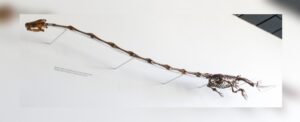
Lifestyles of the Reptilian and Famous? A recent study of fossil records sheds light on the ecological evolution of a variety of creatures in the ancient seas of earth’s Mesozoic period. While the dinosaurs roamed the terrestrial surface, giant creatures such as ichthyosaurs and plesiosaurs (two kinds of marine reptiles) swam the oceans. These giants (some measuring over thirty feet long!) were examined for where they lived, how they moved through the water, and what they ate. The complex analysis led to six different categories of marine reptiles, separating them into widely diverse groups such as active predators within the water and reptiles that also foraged on land. Many more details about the habits of these venerable reptiles of the sea may be found in the article here.

A New Lizard Cousin South of the Border

That alligator lizard zipping furtively around your yard may never know it, but its relative, a new species of Abronia (alligator lizards), has been discovered and named in the western Chiapas region of Mexico. The full scientific designation for the reptile, Abronia morenica, pays tribute to the brown coloring of this handsome lizard and to the Sierra Morena region it comes from (“moreno” meaning brown), which some may remember from the traditional song “Cielito Lindo.” The inhabitants of the Sierra Morena are justifiably proud of this rare discovery deep within the montane cloud forests of the region and are working with scientists to protect its endangered population. A more complete summary of the article (taken from a paper published in the journal Herpetologica) may be found here.

RARN: A Retrospective, Part 2

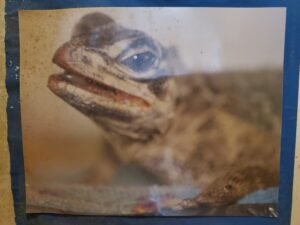
Last week’s post, based on our recently-rediscovered, 25+ year old RARN event display, focused on an iguana that had been poorly cared for, that ended up healthy and contented. This week we offer the story of a water dragon suffering from her (probably well-intentioned but clueless) owner’s terrible husbandry—with another reasonably happy ending. The female dragon “was kept in a poultry-net cage (chicken wire), where she kept rubbing her face against the wire, trying to get out. Repeated scraping of the skin off her nose and mouth resulted in so much scar tissue building up that she [could] no longer breathe through her nose.” The creature lost eight of her front ten toes due to the sharpness of the chicken wire, and when brought in to RARN was emaciated and dehydrated, with a mouth infection. But again, our caring corps of RARN volunteers went to work on the water dragon, so that later, she became “healthy, robust and active, and … adapted well to getting around with her deformed feet.” Names and faces have changed over the years, but the song remains the same – RARN helps scaly (or amphibious) creatures in need!

RARN: A Retrospective, Part 1

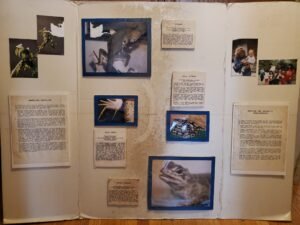
Recently, we volunteers at RARN came across an old-style cardboard display put together for reptile events, discussing RARN’s work taking in sick, abandoned and injured animals. It dated back at least 25 years! Reading some of the descriptions of animals RARN had taken in was hard, and we feel for how difficult it must have been for volunteers to deal with mistreated creatures back then. One surrendered juvenile green iguana had been kept in deplorable conditions: “Between being too cold, and the pieces of vegetable [fed to her] being too big, she could not eat and became emaciated. When rescued, her skin was entirely black and crusty, with scabbed-over, infected scratches.” But because RARN did its job, the animal was well cared for and had a happy outcome. “After two weeks of proper food and heat, her skin split and shed. Two sheds later, she was a healthy bright green.” Here’s a picture or two of the display. We’ll return to the past work RARN has done in future posts!

Should These Pythons Be Called On the Carpet?

For sheer newsy entertainment, this piece from Australia truly has it all. Impressively hefty, well-fed snakes? Check. In a duel over a female? Check. Not stopping their battle until they crashed through the ceiling of a house into the kitchen? Check. Causing no end of consternation to the homeowners by then going elsewhere in the house to cool off their ardor-driven enmity? Got it! Fortunately, no carpet pythons seem to have been harmed in the making of this article. A bit of Labor Day levity for those who love reptiles. The full article may be found here.