News

Waiting Game: Zoo Keeps Rescued Reptiles (and Progeny) Until Habitat Is Restored

The bad news? Last year, a terrible shipping fuel spill contaminated the habitat of several critically endangered reptiles on the island of Mauritius, including two species of skinks and the lesser night gecko.

The good news? Folks at the Jersey Zoo (no, not that Jersey; it’s the island of Jersey in the English Channel, which has a great, conservation-minded zoo) have brought those reptiles that were able to be rescued into breeding programs there, with an eye toward eventual restoration to their habitat.

The fuel spill accident occurred during the height of Covid (August 2020) and forced gas-mask-clad rescuers on the island (located off Madagascar) to scoop up quickly whatever creatures they could find, as the fuel spill was toxic to them as well. The two varieties of skinks (Bojer’s skink and Bouton’s skink) and the gecko species are breeding well, in a genetic conservation program known as an “ark”. But the creatures may have to wait a while until they can get back to their ancestral home (and into their ecologically important niche): the oil has quite possibly contaminated the area for decades. More details of this harrowing but heartening rescue story can be found here.

We hope these beautiful, winsome creatures are soon and successfully restored to their home territory. And we give kudos to the hardworking conservationists involved in their rescue!

A Snake By Any Other Name: Art Helps Solve a Longstanding Herpetological Mystery

According to a recent article, a new species of snake has recently been identified in India, thanks in no small part to the work of artists from nearly two centuries ago.

Interest in the newly-designated Joseph’s racer (Platyceps josephi) was rekindled in 2016 when scientists in the Indian state of Tamil Nadu found a snake that, well, just didn’t look right. It was similar, but not identical to, the banded racer, a well-known snake found in the area. Research confirmed it was not that snake. But what was it? After a lot of sleuthing (including examining snake skins preserved for over 200 years), and many false leads, the scientists went back to artists’ paintings dating back to 1836. The paintings were produced, and many others collected, by Danish zoologist Theodore Cantor, who worked for the British East India Company to produce what was essentially a catalogue of zoological species. After careful study, the scientists in India realized that while the artists’ depictions were meticulously accurate—even to the number of scales on some snakes’ heads—they had sometimes been mislabeled. The modern scientists set about rectifying that misidentification. Their findings may well impact the conservation of this animal and its habitat, as it is much more rare than its “false friend,” the banded racer.

And so the handsome Joseph’s racer, long mislabeled and unsung, now comes into his own!

Excuse Me, But Did That Patch of Moss Just Jump?

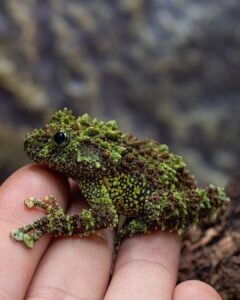
We’ve not posted much lately (sorry!), but we’re back with a brief note on a very, very strange-looking creature that’s been in the newsmemes of late: the Vietnamese mossy frog. These wonderful creatures, Theloderma corticale, dwell within critically-threatened rain forests in—you guessed it—Vietnam. And they really blend into their habitat! Their color (green with black spots), together with their spines and tubercules, really make them look like splotches of moss. This disguise is enhanced by their strategic placement in small bodies of water, where they lurk with their eyes just above the surface, so they can keep a keen watch for predators (and presumably can also spy tasty bugs). More information can be found on the Smithsonian / National Zoo’s article on this frog.

But as odd as these creatures may seem, at least they just look like something innocuous like moss. Mossy frogs have a relative, the warty tree frog (another Theloderma), which looks just like…bird poop!

Slither Over and Make Room! Another Snake Species–and Genus–Is Found

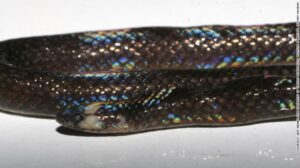
A recent CNN article highlighted a fascinating new find by scientists: a brand-spanking-new species of snake. Levitonius mirus, the Waray dwarf burrowing snake, is found only on two islands in the Philippines. This elusive, diminutive creature—only about as long as a pencil—has among the fewest vertebrae of any snake species in the world. Its iridescent scales make it one of the more striking as well.

The snake’s “discovery”—it has never been found in the wild, only identified by preserved specimens--happened almost by accident. The lead scientist had been studying another genus, which this snake had been misidentified as. DNA analysis, however, proved the tiny snake had been miscategorized, and the scientist was able to describe a new genus and species altogether. Its name, the article notes, derives jointly from another researcher of snakes in the Philippines, Alan Leviton, and the Latin word for “extraordinary”, which aptly fits such an unexpected find.

The snake’s discovery further underscores the need for biodiversity collections so that researchers can tease out the subtle differences as well as similarities between all manner of flora and fauna.

Welcome, Levitonius mirus! We’re glad to add you to our knowledge of the wonders of our planet.

Gulliver’s Amphibian Travels? Among Other Rare Species in Bolivia, Scientists Discover the Tiniest Frog

We didn’t get to this story during the holiday season, but we’re happy to note that researchers continue to find previously unknown plant and animal species on our wondrous planet. Among the notable recent discoveries in the Bolivian Andes’ Zongo Valley—including orchids and a variety of butterflies--was the Lilliputian frog (its name taken from Jonathan Swift’s prose satire), a creature no more than one centimeter long but still undeniably winsome. These minute amphibians proved quite challenging to locate, as their size and camouflage-coloring made scientists have to track them by sound--and they would fall silent just as researchers approached! Other newly-found species of interest to those who love reptiles and amphibians are the devil-eyed frog, the Bolivian flag snake (named for the colors that parallel those of the country’s banner), and the mountain fer-de-lance. Welcome tidings for the new year!