We in the herpetological community are aware of the many fascinating and strange ways in which reptiles and amphibians go about the process of reproduction. Male iguanas (and other reptiles) with not one but two mating organs (called hemipenes)? Check. Turtles whose offspring’s gender is determined by heat during the time they are gravid? Check. Lizards that can switch from one gender to the other in order to bring forth their young? Check (that would be whiptails, by the way). Yeah, that parthenogenesis is not just for gods and goddesses anymore!
But this particular reproductive innovation is a new one on your editor….
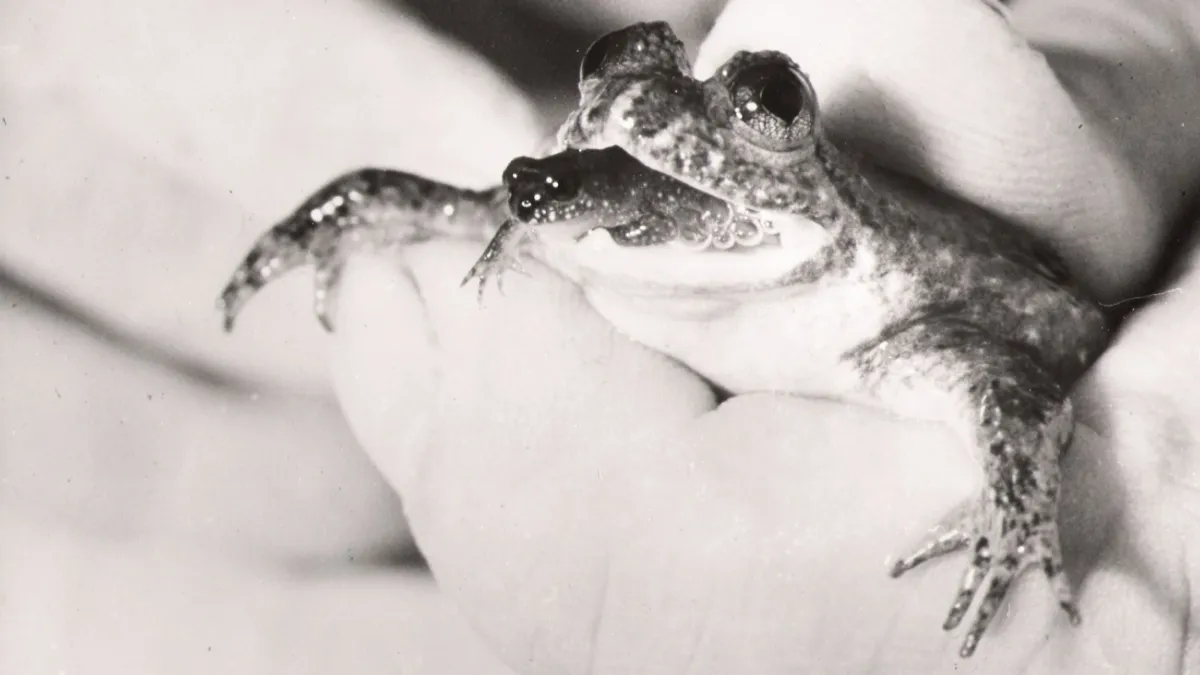
There was on this planet—and for a good long while--a species of frog that gave birth…through its mouth.
The species, Rheobatrachus silus, native to Queensland, Australia, was known for its unique ability to do gastric brooding, in which the frogs mate and the female…swallows her fertilized eggs. Her stomach then serves as an impromptu uterus until…well, until things cook and the froglets hatch.
Alas, it is no more. The species (and a related species, Rheobatrachus vitellinus) went extinct over 40 years ago. They succumbed to a human-activity borne pathogenic fungus that has decimated if not wiped out other frog species across the world.
That’s the bad news.
But there’s good news. They may have the slightest chance to bring it back.
Seems they were able to freeze a specimen just as it joined the Choir Eternal. And they embarked on experiments seeking to re-create the unique frog.
This de-extinction proposal is part of a larger “Lazarus Project” seeking to bring back extinct species from the Great Beyond. This one seems to have a (frog) leg up (if you will) on the others. The frog in question hasn’t been dead for all that long, and the specimen was complete and in remarkably good shape (for a frozen, dead frog, that is). The researchers were able to create “many hundred somatic cell nuclear transfer experiments” to produce early stage (blastula) embryos which were confirmed to contain the frog’s nuclear DNA.
Alas, the specimen was a juvenile, and so contained neither sperm nor eggs. So the chances of bringing the species back are slim at best. Still, researchers have a few other techniques to refine before they give up. And they are learning a lot for the larger project of bringing back extinct species.
Here’s hoping they hop to it!