News

Reunited, And It Feels So Good!

Shortly after the Covid lockdown, RARN got a phone call from a worried resident of Woodland Hills. The person had found a gravely injured turtle—an adult female map turtle, “Mappie”, to be precise—in their front driveway. They had no idea what to do but found RARN and soon brought the animal in. Mappie’s front feet had been chewed off by some predator, probably a raccoon. She was no doubt in pain and would probably have died if the neighbor had not contacted RARN.

Sabine Bradley, RARN’s president, had cared for similar wounds on a red-eared slider before and knew what to do. Mappie was put on the antibiotic Baytril (using the correct dose for her size) and was kept spotlessly clean. During the day Mappie was brought out of the water and put into a container with a towel to let her dry out and give the wounds time to heal. Slowly but surely (well, she IS a turtle!) Mappie’s injured tissues dried up and fell off. She was getting better.

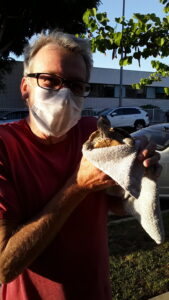
A few weeks later, because the neighbor had put out flyers about finding a stray turtle, RARN got another call: Mappie’s owner, who lived next door to the neighbor! He had a large outdoor pond with a number of turtles and was horrified that his turtle had been taken or had wandered away. Sabine told him she was happy to give Mappie back but she could not release her in her present condition; she was still too injured and needed continued doses of antibiotic. The owner was content to wait until his turtle was ready to come home.

That just happened last weekend! Five months after Mappie had her very sad adventure, she had a joyous homecoming. And she came home to a brand-new, beautiful indoor pond. Her owner decided it was too risky to have his animals subject to predators outside.

Here is a picture of the happy reunion!
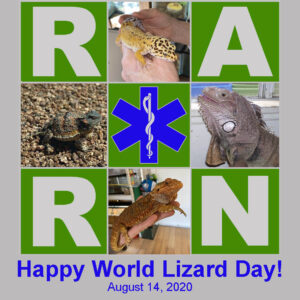
Happy World Lizard Day!

A very happy World Lizard Day to all of you from all of us here at RARN!

Please remember to hug your lizard today. (If they are the kind that actually likes hugs. Otherwise try chucking them under the chin or a friendly tongue lick!) And give them an extra one from us.

A frog by any other name…

A strange-looking frog with an unfortunate resemblance to a part of human anatomy is facing an even more unfortunate fate: possible extinction. Known as the "scrotum frog," this large South American amphibian (it can grow up to eight inches long!) has seen its numbers decline alarmingly in recent years, mostly likely due to overfishing as a food source and pollution of its habitat, Lake Titicaca (well, it had to be there, didn't it?). Considered an "indicator species," this giant frog's lessening population is a dire forecast of the relative health (or lack thereof) of its ecosystem. Scientists and other organizations across the globe are teaming up to try to save this unique, endangered animal, as well as preserve this important body of water from further degradation. Let's hope they put together a....package deal? You can read the full article here.

Respect for pythons? Snakes may hold key to treating disease

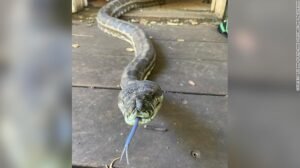
Studies of snake metabolism may sound prosaic, but researchers at the University of Alabama are discovering surprising truths about how our scaly legless friends process their food, with a possible big payoff. Snake keepers and reptile fans know that snakes often go fasting for some time before they "feast" on their prey, usually an oversized meal that goes on being digested for some time. Scientists studying python digestion are discovering an enormous spike in the metabolic rate after feeding, in which a "torrent of stomach acid" is produced to break down the prey, and their intestines are engorged several times their normal size. The research is now studying the actual DNA involved in the process, with promising future possibilities for treatment of cancers and other human diseases. The full article (not for the snake-squeamish!) can be found here.

Skink On The Brink

A recently discovered / scientifically described skink's very existence currently hangs in the balance. Australia's recent bushfires have nearly wiped out the habitat of the extremely rare (and nearly legendary) Kaputar rock skink. It is feared that one more fire in its habitat--at the summit of an extinct volcano in New South Wales--may send this very handsome creature into extinction. A very detailed article discussing the skink's unique habitat and history may be found here.