This summer, a trip to Prague, Czech Republic (part holiday, part business) led to a most delightful discovery: frogs in the middle of the venerable city!
Specifically, we stumbled upon the amphibians in an intricately ornate terraced garden in Prague's Mala Strana neighborhood: Vrtbovska zahrada, the Vrtba Garden. This immaculately tended Italianate garden, a baroque gem from the 18th century at the foot of Petrin Hill, had been developed for the highest officer attached to Prague's Castle: the burgrave of Bohemia, Jan Josef, count of Vrtba. Though the burgrave's palace no longer survives as it was, the lovely formal court gardens endure (though they underwent renovations some 25 years ago). We were fortunate to have this rose-scented bower as the setting for a theatrical performance we were attending.
Five minutes into the performance, however, a creature hopped over my foot. I knew by the light touch it had to be a frog or toad. All evening long I was entranced by the play, but even more enchanted by having had an amphibian make its presence known to me, a stranger in town!
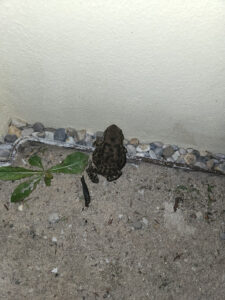
After the performance we wandered around the lush fountains and—of course—found more frogs. There were LOTS of frogs. And that spoke well of how the gardens were being kept—amphibians do NOT do well in the presence of heavy pesticides or insecticides. And these fellows were well fed. Who knows how long they had been breeding there?
But light was fading fast, and we could only snap a couple of pictures before our amphibian friends disappeared into the ponds and hedges. When we first saw them, we thought the bumpy, dark-patterned creatures were toads. (They may still be, by the way) But after some research—thank you, iNaturalist!—I believe we can identify these winsome anurans as specimens of the European Common Frog (Rana temporaria).
But here's the rub: the name. Common? A frog from the gardens of a chief courtier, common? Not possible, say we! Ah well. Common or not, the frogs in that garden at least did not seem endangered.
Here's hoping all readers have similarly engaging amphibian adventures in your travels!

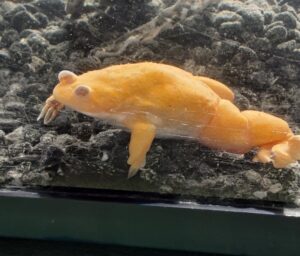
 Consider, if you will, the African Clawed Frog. A species that, in the 1930s, was discovered as an efficient way (though not to the frogs!) to determine human pregnancy. After other, better methods were found, the frogs morphed into animals found in many a pet store. But along the way, many of these creatures--both discards from research and escaped or abandoned pets--found their way into the broader ecosystem of the US.